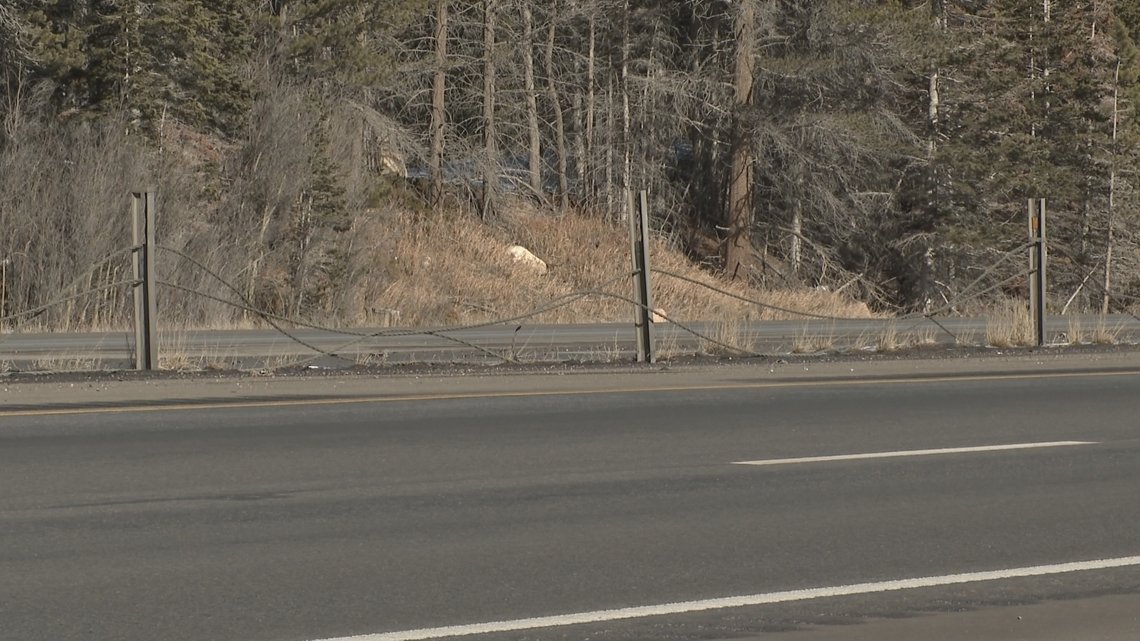
A broken safety barrier remains unrepaired days after a fatal crash on I-70, sparking concerns over maintenance and timely repairs to prevent future accidents.
CLEAR CREEK COUNTY, Colo. — Five days after a snowplow crossed the median on Interstate 70 and crashed into a van carrying a California youth hockey team, a key safety barrier near the crash site remains down.
Colorado State Patrol is investigating whether a cable guardrail near the Eisenhower Tunnel was functioning properly at the time of the crash, which killed the van’s driver and injured members of the team. On Wednesday, 9NEWS found sections of cable barrier were still loose or lying on the ground for hundreds of feet nearby.
Interstates across Colorado are lined with protective barriers designed to prevent crossover crashes into oncoming traffic. Many are made of concrete or steel, but cable barriers are commonly used in rural stretches because they are faster and less expensive to install.
“Cable barrier has revolutionized roadside safety in that it can be deployed quickly and relatively inexpensively in rural communities,” Steve Eimers said.
Eimers became an advocate for roadway safety after his 17-year-old daughter, Hannah, was killed in a guardrail-related crash in 2016 in Tennessee. He now studies barrier systems nationwide and pushes for faster repairs when they fail.
“We are very, very fortunate that just one life was lost,” Eimers said of the recent I-70 crash. “It could have been far, far more significant loss of life. The death of one man though is still a tragedy and still preventable. Luck is not a safety strategy.”
According to Eimers, cable barriers can be highly effective when they are properly tensioned and maintained.
He said they’ve been known to stop semitrucks, but are generally far less effective against heavy vehicles than concrete barriers. He says maintenance is critical for ensuring they work properly.
“If the cable is loose or lying on the ground, it is nonfunctional,” he said. “It cannot do its job, and that entire area is, at that point, vulnerable to a crossover collision.”
Eimers also questioned why repairs had not been made days after the crash.
“In my experience, this is an emergency repair,” he said. “When you call 911 for a fire, you put it out. We should be doing the same type of response. We should treat this as the emergency that it is.”
The Colorado Department of Transportation declined to answer questions about the condition of the barrier before the crash, citing the ongoing CSP investigation. After repeated requests about repair timelines, a CDOT spokesperson said crews are “working to repair the guardrail as soon as possible.”
When asked if the guardrail was functioning properly at the time of the crash, a CSP spokesperson wrote, “That will be determined by the investigation.”
Eimers said timely repairs are one of the most effective ways to prevent mass casualty crashes.
“It’s impossible to measure things that don’t happen,” he said. “But if we make timely repairs of cable guardrails, it will save lives.”