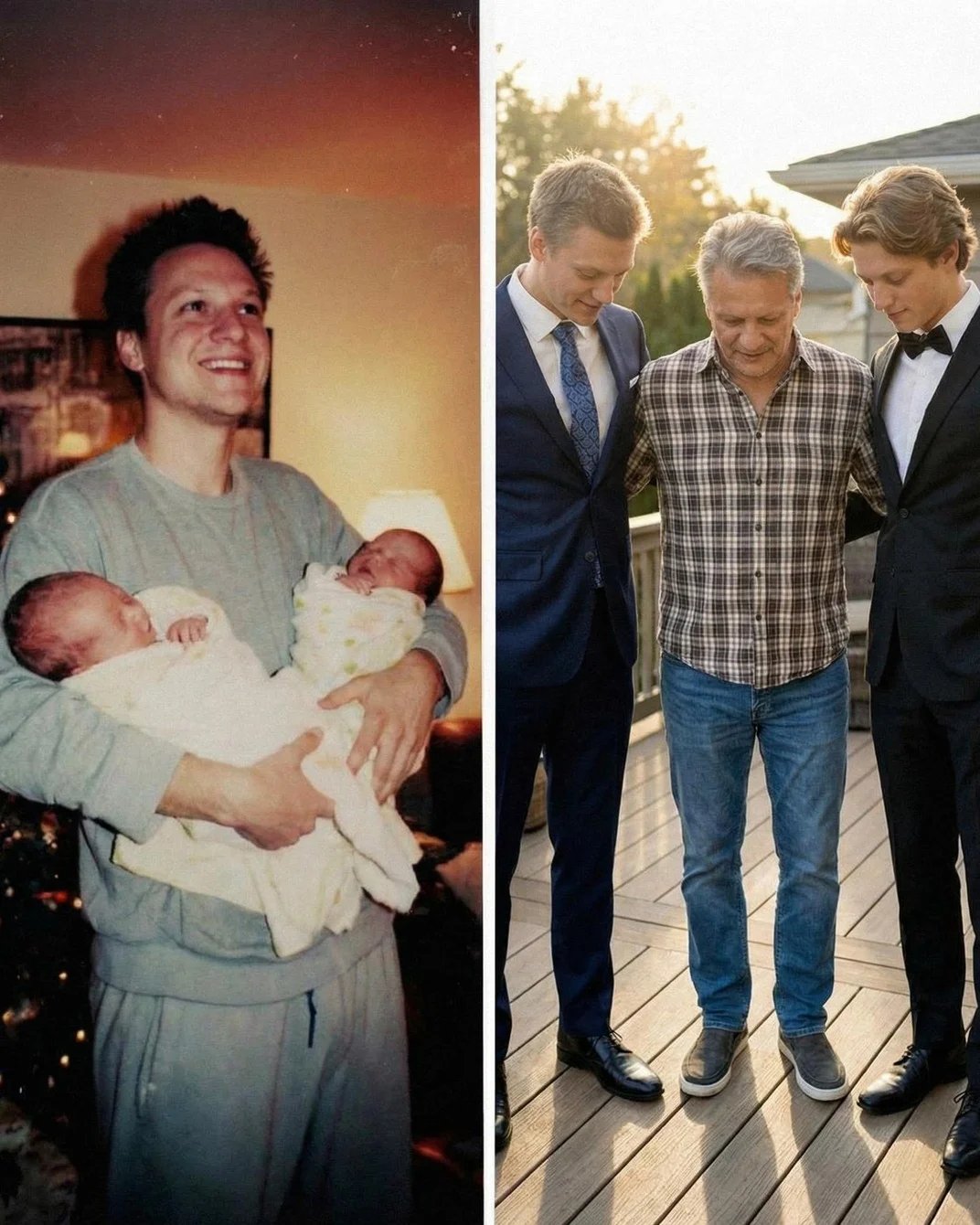
The journey began in a house of silence, where a young father woke to find an empty bed and two crying newborns. Vanessa’s departure, driven by the crushing weight of sudden responsibility, left behind a vacuum that redefined the meaning of family for the seventeen years that followed. For the narrator, those early years were a
“blur of exhaustion,” a period of balancing relentless work and late-night feedings with a hand always reaching to steady a child. This phase was not merely about survival, but about constructing a stable foundation of truth for Logan and Luke, ensuring they understood that while one parent wasn’t ready to stay, the other was immovable.
Raising twins in the absence of a partner necessitated a radical reshaping of the narrator’s life, requiring him to swallow his pride and accept community help while working tirelessly to provide. Over nearly two decades, the father and sons built a unique rhythm, forged in the fires of shared experience and a quiet pride in the life they had crafted.
The boys grew into thoughtful, protective young men who understood stability as something earned through physical and emotional presence. Their upbringing served as a profound testament to the idea that a family’s completeness is not measured by its traditional structure, but by the consistency and depth of the love provided day after day.
The equilibrium of their lives was jolted on graduation day when Vanessa reappeared on their doorstep, seeking to reclaim the title of “Mom” after nearly two decades of silence. While she framed her return as a byproduct of long-held maternal longing, the narrative quickly revealed a more transactional motivation: she was “worn down” and seeking sanctuary because she had nowhere else to go. This unexpected encounter forced a collision between the father’s buried memories and the sons’ grounded reality. The timing of her return, just as the boys were about to step into their adult lives, highlighted the opportunistic nature of her reappearance, which stood in stark contrast to the seventeen years of absence she hoped to bridge.
Ultimately, the resolution came from the sons themselves, whose clarity in the face of their mother’s return stunned their father. They rejected the notion that love could be reclaimed “when it was convenient,” choosing instead to honor the seventeen years of devotion provided by the parent who had stayed. While the father offered her resources and help to find a place elsewhere, he drew a firm boundary against her reintegration into their private world, prioritizing the emotional health of his sons over the ghosts of the past. As they walked together toward the graduation ceremony, the lesson was final: love is not proven by returning when life is hard; it is proven by the decision to stay when it is harder, a choice the father never once regretted.
The post The Choice of Staying: A Legacy of Single Fatherhood and Reclaimed Boundaries appeared first on .